Nov 8, 2015

How to travel around the world for a year

How to travel around the world for a year

While my last post covered my previous year traveling, writing and programming, this article will go into the specifics of planning your own round the world trip, including flights, costs, activities and accommodation. I’ll show you how affordable traveling actually is, and how to plan your own adventure.
“Travel is fatal to prejudice, bigotry, and narrow-mindedness.” 
I think it’s especially important for people to get out of the Silicon Valley echo chamber, to travel and get some perspective. Traveling opens your eyes to some of the real problems people face, and gives you the opportunity to come up with solutions to tackle those, rather than some of the more trivial ideas closer to home. You can’t fail to come away from traveling inspired with a fresh perspective and new ideas.
Stuck in Customs

Choosing where to go

Choosing where to go can be overwhelming at first, especially when you have no idea about the countries involved. I’d been to South Africa for three months the previous year, so I decided to start with some familiar territory to get into the rhythm of traveling.
For the subsequent countries, I visited Trey Ratcliff’s HDR photography blog,stuckincustoms.com. In fact all the photos in this post are taken by Trey. The guy has travelled the world and been to some incredible places. I simply went through the countries he crossed, and added the most beautiful ones to a list. Ultimately that list ended up as:
South Africa, Hong Kong, Singapore, Malaysia, Thailand, Cambodia, Vietnam, Japan, Australia, New Zealand, Hawaii, NYC, SF, Costa Rica, Panama, Peru, Bolivia and Argentina.
My aim was to see as much as possible in that one year, and then revisit places properly in the future. If you don’t have as much time, I’d recommend focusing on an area, perhaps Asia. For example, for my next trip I’m planning to:
Start in Beijing. Take the train to Tibet. Go down to Nepal. Travel overland to India. Make my way down to Mumbai. Fly to South East Asia and travel through northern Thailand, Cambodia, Vietnam and Laos.
So in other words, where you want to go depends on your time, budget and inclination.
Stuck in Customs

Organizing flights

Round the world air tickets have made traveling a piece of cake compared to the hassle of the past. My grandpa had to fly with the Queen’s Messenger to Bhutan in a decrepit plane, which lost one of its engines half-way through the flight, and had to perform an emergency crash landing. To top it off, after the necessary repairs were made, he was asked to continue his journey in the same plane! How times have changed.
You can either book your flights individually, which gives you the maximum flexibility, or book them all at once with a round the world plane ticket; the cheaper option. I chose the latter, as the amount of flights I needed wasn’t going to make buying them separately economically viable.
Round the world ticket prices range from around ~$3k to ~$7.5k USD. I got 16 flights for about $7k, but it really depends on the time of year, the areas you’re flying to and where you start your journey. One good tip is to start and end your journey in a less affluent country, as ticket prices are usually much cheaper.
I used oneworld for my ticket, and I’m pretty happy with them. They’re a conglomerate of AA, BA, JA, CP and others, and offer a convenient online booking tool to plan your journey; no point giving commission to a travel-agent when you can plan it yourself. One advantage of oneworld is that they let you change the dates of your flights for free. Location changes aren’t free, so make sure you get those right the first time.
RTW tickets have a number of restrictions, which differ from airline to airline. Some of them limit the amount of miles you can fly, others the actual number of flights. Most only let you fly in and out of a continent once, and require you to fly in a general direction (i.e. always east). You have to spend a minimum of 2 weeks in each place, and most tickets expire after a year. The reason behind the limitations is that they don’t want people using them for commuting, so keep that in mind when buying them.
I advise you to use the round the intercontinental flights for the long continental flights, and then if necessary book short internal ones. Asia and South America are pretty easy to get around without having to take flights everywhere, whether it’s by the local buses, coaches, buying a car or hitch hiking. I definitely recommend you to restrict air travel as much as possible, and instead travel by land; you’ll see and experience much more.
Stuck in Customs

Packing

Pack as lightly as possible as you’ll need to carry everything you take with you on your back. This is especially important from a security standpoint too, as the more you take, the more you’ll have to keep an eye on.
I just bought a 90 liter rucksack off ebay, and stuffed one weeks clothing into it, a towel and my camera setup. In Malaysia I actually sent back my tripod and wet suit, they were too unwieldy and heavy to take any further. Anything you don’t take and find you need, you can buy locally. In fact, thisminimalistic lifestyle has stuck with me, and is one of the things I most appreciate about traveling.

Budget & Accommodation

Accommodation is easy, especially when you travel through some of the cheaper places in Asia. I was on a bit of a budget, so generally ended up in hostels - except for the odd hotel in Asia and South America. Good hostels aren’t hard to find, especially when you can do a bit of research online.Hostel World is a good start, along with the Lonely Planet and Wikitravel. Some places are really well set up for travelers, like New Zealand, while it can be trickier in others, such as Hawaii and Japan.
Hostels are also a great way of meeting people and getting advice on where to go. You’ll always find interesting people; I’ve met semiconductor chip designers, professional divers and quantum encryption experts. I’ve met traveling companions and created friendships I’ll have for life. This is half the fun of traveling.
As for the total budget, I planned for about $15k for the whole year, for both accommodation and food. It turned out that number was about right, and I wasn’t living too cheaply either - eating out every night at local restaurants. It’s always a good idea to have a buffer in the bank though, for the peace of mind.
Stuck in Customs

Cash and Electronics

All the countries I went to had ready ATMs to hand, so getting cash wasn’t an issue. My card was cancelled three times though by my bank, suspecting fraudulent activity. I advise you inform your bank of your travel plans, so as not to run into this problem. Take out a few credit cards, and stash them in different places to be on the safe side. Even better, try to find cards that don’t charge your an international transaction charge, as this can quickly add up. A lot of places won’t accept cards, so you’ll need cash on hand.
I didn’t bother with a mobile phone for the entire year, instead just using an iPod touch and Skype. This isn’t as crazy as it sounds, and it’s actually a good feeling to disconnect and go. People can get in touch with you when you choose. If you do take a mobile, get an international plan and keep an eye on it - they can get stolen pretty easily.
I took a Nikon SLR and Macbook everywhere, as well as a bunch of other electronics. Frankly the world isn’t the wild west that some people seem to think it is, but you just have to use common sense and keep things close to hand. I may have just been lucky, but in my whole trip, I didn’t have a single thing stolen.
Plugs (sockets) are something to research too. Whilst most of Asia has similar plugs, you can get caught out from time to time. Likewise none of the plugs in Latin America are grounded, so three pronged US plugs won’t fit. Getting an international plug adapter is a good idea!
Wifi is available practically everywhere (Vietnam often has better internet than the US in my experience), and the only trouble I had finding it was some of the remotest parts of Africa. If you are going somewhere particularly remote then you might want to invest in a 3G dongle. Buying it locally is usually the cheapest option.
Stuck in Customs

Activities and Planning

Don’t, whatever you do, choose a package. I just booked the first two nights in the city I was flying into, and then took it from there. Sometimes I wouldn’t even do that, and just fly in. You have to leave room for spontaneity in your plans, don’t try and plan everything in minutia. Your plans will generally change anyway when you arrive and get advice from other travelers. Be flexible and adapt.
I personally didn’t use guide books, but the staple guide is the Lonely Planet. Buy these in the countries when you arrive. If you buy them locally, or in the airport you’ll overpay.
WikiTravel is a great resource, and one I used every day. However, the best resource is advice on the ground from fellow travelers and locals. I used to jot down all the great advice they gave in a little black notebook. And it doesn’t have to be advice about the country you’re currently in. I remember an Argentinian guy I met who drew a map of South America in my book, listing all the places he recommended in Peru and Chile.
Stuck in Customs

Companions

Companions are down to you. I personally prefer traveling alone, forcing you to meet more people and make friends along the way. If you do travel with people, make sure you’re good friends, as traveling for extended periods can get frustrating.

Visas

If you’re lucky enough to be an American or European citizen, then visas are not an issue. The only country that wouldn’t give me a visa at the border was Vietnam, and I just paid a guy at a Cambodian hostel to take my visa to the Vietnamese embassy and process it. It’s worth doing a bit of research on this in advance, but it usually isn’t a problem.

Health insurance

For health insurance I just used World Nomads. They’ve fairly competitive rates, and are one of the more dependable options.
That said, it’s often a case of staying lucky and not doing anything stupid. All the insurance in the world won’t help you if you have an emergency in a remote part of Africa.

Lifestyle

I’d usually stay in the same place for at least a few days, sometimes up to a week, before moving on. However, when you’re moving so much it’s sometimes nice to have a bit of grounding every now and again. Whenever I got this feeling I’d stop for a few weeks, and stay in one place. For example, I did this for two weeks in Ho Chi Minh, when I needed to make some progress on the book.
As for exercise, if I wasn’t surfing I usually ran along the beach for at least half an hour. Having more time you can dedicate to your health is one of the major benefits of traveling. After a few months of surfing and running every day I was the fittest I think I’ll ever be.
I found I needed some intellectual stimulus too, and writing the book was my way of achieving this. Without that I’d have to occupy my mind with other pursuits, such as reading and programming. It’s important to keep this intellectual balance in mind, especially when you’re traveling for an extended period.
When I finished the book, I started hacking on open source projects, and created Spine. In fact, the first version was written on a particularly long bus ride in New Zealand. It’s amazing how you can plug in the earphones, zone out the distractions and focus wherever you are.
Whenever I was traveling to a new city, I pinged the Ruby mailing lists a couple of days before hand to see if anyone was interested in meeting up. More often than not it worked out, and I had people to hang out and ask for advice. In Tokyo and Hong Kong I gave tech talks, whilst in Sydney and Cape Town I ate out with the local Ruby teams.
Programming communities can give you an immediate link and base in a new city, they’re an incredible resource.

Experience

Traveling round the world you will you see and experience more than you ever thought possible. You will eat like a king, from delicious fruits you’ve never heard of in Malaysia, to the best steak you’ve ever tasted in Argentina. You’ll climb mountains in New Zealand and hike down Canyons in Peru. You’ll surf incredible breaks in Costa Rica and party like there’s no tomorrow. You’ll meet some amazing people and have life changing experiences.
Quite simply, traveling the world will be one of the best decisions you’ll ever make.
Stuck in Customs

Total cost

So the net cost for the trip was about $22k. I paid for the vast majority of this with one month’s consultancy beforehand. That’s crazy when you think about it, one month’s consultancy in return for a year traveling. And I certainly didn’t hold back with the budget, I met a lot of people doing it for much cheaper. Where there’s a will, there’s a way.
It’s also possible to turn this into a lifestyle by paying for it on the road. If you’re a programmer, you can definitely contract remotely, even if it’s only for part the year. Your clients don’t care where you are, only that you get the work done. The process for getting yourself into this position is the same as becoming a successful contractor. Practice and networking.
The only other thing to consider is that quite frankly, time is running out. The older you get, the more baggage you’ll get tied down with, and the harder it is to do something like this. You should be optimizing for experience in your life, rather than money.
Motivation consists of two things, increasing ‘want’ and increasing feasibility. In other words, to motivate you need to increase the desire for something, and increase the reality of attaining it. Hopefully I’ve done both with these posts. It’ll be great to see more programmers traveling.
Stuck in Customs

Jun 12, 2012

Things that happen when you're not paying attention


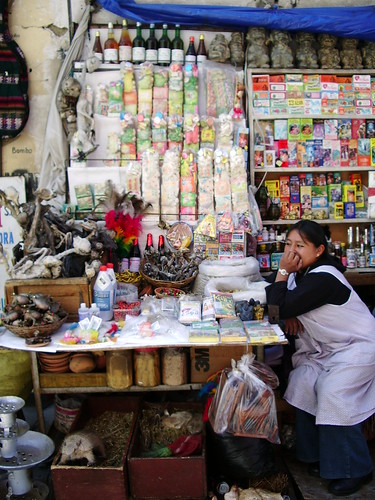
Witches Market
Witches Market in La Paz
You're in a new country, you can't speak the language very well, things occasionally tend to go tits up.

We were in Bolivia's capital, La Paz about to head down to the southern town of Sucre. As we bought the tickets for our comfy bus, we thought it odd that the guy behind the counter was motioning at us to check our backpacks in already when we had ages to go. It's like going on a plane. You check the bags in at a counter and you're given a ticket with which to collect it at the other end. Still it was easier eating horrible 'station cafe' grub without lugging our huge backpacks with us.

So, we headed to board our 7:30pm bus. The first hint of panic came when we handed our tickets to the guard and he stared at us with a shocked look muttering, "salida, salida" and pointing at the door. Jody and I gave each other blank looks but when we headed back to the cashier' s desk to complain about the crazy man, we finally got it.

The bus already left - almost an hour ago! And not only had we wasted our money but our sodding backpacks were still on board! Everything except the clothes we were wearing and passports were in those bags and now there was a distinct possibility we'd never see them again. Complete stupidity turned into blind panic. Our luggage was winging its way across the country on a luxury bus - without us.

The only course of action was to get the next available bus and chase our bags across the country. Unfortunately for us, we were going to have to go 10 hours to Potosi (the highest city in the world and one we'd been trying to avoid) and then find another bus on to Sucre. However, we'd heard so much about the bag thieves in South America that despite the cashier's reassurance that when we got to the other end we'd just have to show the tickets to get the bags back - we were already getting frantic.

And luck definately wasn't on our side. The only other bus leaving that night was a 'normal' coach (very cheap but cramped) and it seemed like every Bolivian in La Paz wanted to get on it. Women with kids, women carrying sacks of Bolivia t-shirts, a group of drunks (who got the back seats and shouted all night) and some old women, who had a row over seats so fierce that the conductor had to get on to calm them down.

When we finally left La Paz two hours late, Jody's legs had already seized up from lack of legroom and we were forced to sit through an hour of a guy screaming through the coach about digestive problems, showing a flip-chart of the internal organs as he tried to flog some 'miracle' cure. I pretended to go to sleep but listened as he was laughed at by the other passengers. Unsurprisingly, nobody bought any. Just as I thought we'd got rid of him and could get some peace, another guy got on selling his answer for back problems.

Eventually, I managed to curl my body onto the seat to doze but I have no trouble sleeping on buses. In fact, I have trouble staying awake! However, the worry of the backpacks kept rousing me and we spent a lot of time disecting the contents of our bag wondering which clothes/books/medicines we'd have trouble living without . Apart from one toilet stop (no loo on board), around 4am at a Bolivian version of a 'Little Chef' (some deserted cafe in the middle of nowhere), at least there were no more disruptions.

Despite the much famed attractions in Potosi, we were so worried about the altitude (4100m) that we practically ran into the bus station there and got the first one we could - staying a possible record of about 15 minutes. We managed to see a few of the city's famous churches as we left. With it being a Sunday, the bus driver treated us to a tape of terrible wannabe singers belting out church songs, probably recorded at his local service the week before. No chance of a nap here then either.

Three hours later, Sucre bus terminal looked deserted. We eventually found a guy manning the 'Trans Copacabana' office and after about five minutes of sign language and us waving the tickets at him, he announced that our bags were in the cargo store across the road. I must have looked thrilled as Jody told me not to relax until we'd seen that they were in fact OUR bags. It was a tense moment, but there at the back of the dusty warehouse were our backpacks. I practically threw the tickets at the man. Sucre's a pretty city, but that day we didn't see any of it - we went straight to bed.

Where are we? Still in Sucre enjoying the warm weather. Someone's bravely given us a voluntary job teaching English to people who can't normally afford to learn. I have a class rowdy 10-year-olds while Jody's teens are angelic by comparison.

Leaving La Paz


Sucre market
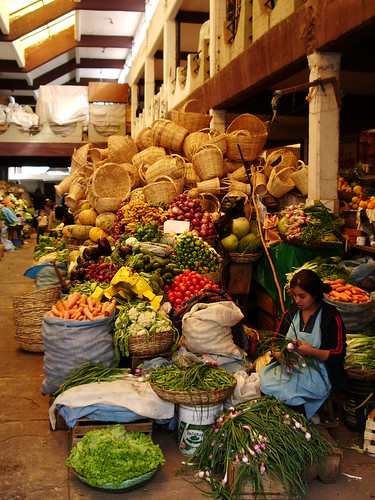
Your standard, rammed Bolivian market
La Paz appears to be back to normal again. The streets are rammed with markets, bus loads of tourists are arriving and you can't cross the road for fear of being run over.

New people checked into our hotel (El Solario) for the first time all week and men are working to repair the ripped up cobble-stone roads (a few days ago, protesters dug them up and piled the bricks for blockades). Hell, it was even warm and sunny today.

Now that the petrol stations are open again there are huge queues for fuel, so bus services aren't back to normal yet. This means that we're stuck here until Monday, before we head to Copacabana.

Although at times things were tense and terrifying, I'm glad that we were here when La Paz was on the brink of civil war. I couldn't imagine a friendlier war zone than Bolivia! It shows the true colours of the people here, that even when they're fleeing tear gas rockets, they still have time to apologise for the mess the streets are in and ask if we need help getting back to our hotel.

We befriended a lot of people here during the trouble, such as shop owners and one person I'm particularly impressed with being on first name terms with - a witch from the witches market . I'm sure if we run into any other problems in South America, she can help us out by rustling up a plague of locusts, or something.

It's great to see that locals are able to earn a living again. And the sight last week of kids playing football on a street that today is once again choked with traffic, will stay with me for a long time.

From now on, we'll resume normal frequency of blog posts (one every few days), because no one wants to hear about La Paz living up to it's name (in English: 'The Peace').

Jun 11, 2012

Urban Gadabout: Jamaica Bay, here I come!

See below for information about the Jamaica Bay Ecology Cruise leaving from Sheepshead Bay, Brooklyn, on June 24.by Ken

Some years back I had the pleasure of providing overnight accommodations to a friend who had a layover in New York on his journey from the Midwest abroad, and because he'd never been in the city, I went to the airport to meet him and drag him all the way back to my place in Washington Heights -- not quite as long a distance as you could have within the five boroughs of NYC, but a long distance anyways.

The Air Train was up and running by then, providing -- for the first time! -- easy access from JFK to the Howard Beach station of the A train for the long trip back to my place, but I still feel kind of bad about what I did. Instead of doing the logical thing and planting us on the Manhattan-bound platform, I dragged my poor friend to the opposite platform, from which the A train begins what I consider an amazing trip across Jamaica Bay to the Rockaway peninsula.


I think of this as one of the amazing rail journeys a person can make for the price of a subway fare. I do it at least a couple of times a year, even if I have no desire actually to be in the Rockaways. I realized, though, that my friend had no interest in this little ocean voyage by rail, or in my labored efforts to explain the geography of our journey. I suppose it was understandable that his mind was more wrapped up in the long and laborious trip still ahead of him, and the several months he would be spending in his remote destination.

I thought about that day when I took my most recent trip across Jamaica Bay, but for the first time not all the way across the bay. At the Broad Channel station, the next stop after Howard Beach, I was getting off to meet a tour group led by the incomparable Justin Ferate, which would begin with a walk through the community of Howard Beach -- an extremely right-wing neighborhood with a heavy concentration of police and firefighters -- as the start of a mile-and-a-half walk to the visitor center of the Jamaica Bay Wildlife Refuge. As many times as I've made the train crossing of Jamaica Bay, I never had any idea there even was such a destination.

I was caught short again when some of my fellow tour-group members not only had never done the Jamaica Bay train ride but really didn't even know where they were. They had followed Justin's instructions (in some cases never having set foot on an A train before) and arrived at the designated subway station and found the designated meeting place, but the rest was a mystery to them.

Jamaica Bay has always been a mystery to me, but not that kind of mystery. I've always been a compulsive map-reader, and when my family moved to New York when I was 12, and I began to become obsessed with the map of NYC, my eyes were riveted by that enormous expanse of bay bounded by the coasts of Brooklyn, "mainland" Queens, and the Rockaways. So when I saw that Justin was doing a walking tour of the Wildlife Refuge, I got my check in the mail immediately. And it was a terrific afternoon tramping around the most accessible portions of the refuge guided by Don Riepe, director of the Northeast Chapter of the American Littoral Society, and the enormously capable and charming Elizabeth, who works with Don.

It was a wonderful but exhausting afternoon, and I'm going to share something with "Urban Gadabout" readers which I somehow managed not to mention to readers of my DownWithTyranny "Sunday Classics" posts. (I'm figuring there isn't much overlap between the readerships, even making the large and presumptuous assumption that either has any readership.)

I've written several posts now based on the New York Concert Artists series of "Evenings of Piano Concerti," including today's, and while it's true that most of what interested me had already happened in the first three concerts, I never got around to mentioning that I blew off the fourth and final one, because that Saturday I would have had to go straight from the Jamaica Bay outing to Good Shepherd-Faith Presbyterian Church on Manhattan's West Side, with possibly time to stop at a conveniently located branch of my gym to shower. And the next day I had walking tours scheduled first in the Bronx (the second walk in Jack Eichenbaum's terrific Municipal Art Society series of South Bronx walks, which began in March with Mott Haven and concludes June 24 with Morrisania) and then in Brooklyn (the New York Transit Museum tour of several historic subway stations, which I wrote about recently).

There's more to that story, including tales of a number of other upcoming events around the city, but I'm going to leave that for sometime soon, maybe even tomorrow, in order to pass on news that Don and Elizabeth shared with us before we left the Wildlife Refuge.
June 24 - Jamaica Bay Sunset Cruises (3pm-6pm)

Leave from Sheepshead Bay, Brooklyn aboard the "Golden Sunshine" for a narrated tour of Jamaica Bay. Learn about the history, ecology, wildlife and management of the refuge and see egrets, herons, osprey, peregrine falcon, terns, shorebirds and waterfowl. Cost: $45 includes tour, wine & cheese, fruit, drink, snacks. Call (718) 318-9344; e-mail: donriepe@gmail.com. You can also make payment here. (With Gateway NRA and NYC Audubon.)

You may have noticed that the date is the same as Jack Eichenbaum's walk through Morrisania in the Bronx. Yes, once again, as with both previous installments in Jack's Bronx series, I'm headed straight from there to Brooklyn!

More about upcoming walking tours of Jack's, and some other tantalizing events, in the next installment.

Apr 17, 2012

Blue Mosque - Istanbul -Turkey

The Sultan Ahmed Mosque (Turkish: Sultanahmet Camii) is an historical mosque in Istanbul, the largest city in Turkey and the capital of the Ottoman Empire (from 1453 to 1923). The mosque is popularly known as the Blue Mosque for the blue tiles adorning the walls of its interior.

It was built from 1609 to 1616, during the rule of Ahmed I. Like many other mosques, it also comprises a tomb of the founder, a madrasah and a hospice. While still used as a mosque, the Sultan Ahmed Mosque has also become a popular tourist attraction.

<< Back

Haghia Sophia Museum

Hagia Sophia (from the Greek: Ἁγία Σοφία, "Holy Wisdom"; Latin: Sancta Sophia or Sancta Sapientia; Turkish: Ayasofya) is a former Orthodox patriarchal basilica, later a mosque, and now a museum in Istanbul, Turkey. From the date of its dedication in 360 until 1453, it served as the Greek Patriarchal cathedral of Constantinople, except between 1204 and 1261, when it was converted to a Roman Catholic cathedral under the Latin Patriarch of Constantinople of the Western Crusader established Latin Empire. The building was a mosque from 29 May 1453 until 1931, when it was secularized. It was opened as a museum on 1 February 1935.

The Church was dedicated to the Logos, the second person of the Holy Trinity, its dedication feast taking place on 25 December, the anniversary of the Birth of the incarnation of the Logos in Christ. Although it is sometimes referred to as Sancta Sophia (as though it were named after Saint Sophia), sophia is the phonetic spelling in Latin of the Greek word for wisdom – the full name in Greek being Ναός τῆς Ἁγίας τοῦ Θεοῦ Σοφίας, "Church of the Holy Wisdom of God".
Famous in particular for its massive dome, it is considered the epitome of Byzantine architecture and is said to have "changed the history of architecture. It was the largest cathedral in the world for nearly a thousand years, until Seville Cathedral was completed in 1520. The current building was originally constructed as a church between 532 and 537 on the orders of the Byzantine Emperor Justinian and was the third Church of the Holy Wisdom to occupy the site, the previous two having both been destroyed by rioters. It was designed by the Greek scientists Isidore of Miletus, a physicist, and Anthemius of Tralles, a mathematician.
The church contained a large collection of holy relics and featured, among other things, a 49-foot (15 m) silver iconostasis. It was the seat of the Patriarch of Constantinople and the religious focal point of the Eastern Orthodox Church for nearly one thousand years. It is the church in which Cardinal Humbert in 1054 excommunicated Michael I Cerularius – which is commonly considered the start of the Great Schism.
In 1453, Constantinople was conquered by the Ottoman Turks under Sultan Mehmed II, who subsequently ordered the building converted into a mosque. The bells, altar, iconostasis, and sacrificial vessels were removed and many of the mosaics were plastered over. Islamic features – such as the mihrab, minbar, and four minarets – were added while in the possession of the Ottomans. It remained a mosque until 1931 when it was closed to the public for four years. It was re-opened in 1935 as a museum by the Republic of Turkey.
For almost 500 years the principal mosque of Istanbul, Hagia Sophia served as a model for many other Ottoman mosques, such as the Sultan Ahmed Mosque (Blue Mosque of Istanbul), the Şehzade Mosque, the Süleymaniye Mosque, the Rüstem Pasha Mosque and the Kılıç Ali Paşa Mosque.


<< Back

Islamic Heritage, Indonesia

Islam has also contributed greatly to the cultural society in Indonesia. As of 2006, 88% of Indonesia's recorded population were Muslim. Islamic culture is prominent in Sumatra, and a few of the remaining sultanate palaces can be seen in Medan and Tanjung Pinang.

The Islamic heritage tourism is also popular, especially among Indonesian Muslims and Muslims from neighboring countries such as Malaysia, Singapore and Brunei that shared common Southeast Asian Islamic heritage. The activity usually linked with Islamic ziyarat pilgrimage to historical Islamic sites, such as historical mosques and tombs of venerated Islamic figures. However for visitors in Islamic sites, either local or foreign, Muslim or non-Muslim, the rules of conduct and dress modesty is applied, such as removing the footwear while entering mosques or makam (tombs), visitor should not entering the site wearing shorts (sarong usually lended near the entrance to cover lower torso of the visitors), and wearing kerudung (head-dress covering) for women.
In Aceh the Baiturrahman Grand Mosque and tombs of Aceh Sultanate kings is popular destination, while in Medan the Medan Great Mosque and Maimun Palace is also major Islamic heritage destination. Most of Indonesian major cities have their own historical or monumental Masjid Agung (Grand Mosque) that become city's landmark as well as tourism attraction. Istiqlal mosque, the Indonesian national mosque and the largest in Southeast Asia is Jakarta's major landmark as well as tourist attraction. In Java the ziyarat pilgrimage is usually linked to historically important Islamic figures of Wali Sanga (Nine Saints), they are important because of their historic role in the Spread of Islam in Indonesia. Their tombs and mosques scaterred along Java's north coast towns, such as Demak, Kudus, Cirebon, Gresik, to Ampel in Surabaya. The 15th century Agung Demak Mosque hailed as the first mosque established in Java. Menara Kudus Mosque is notable for incorporating Majapahit Hindu-Javanese architecture. The tomb of Sunan Gunungjati near Cirebon, is also the important ziyarat site in West Java.


Sumatra Island, Indonesia

Bangka Island in SumatraSumatra Island in Indonesia - Sumatra is a complete tourist destination-sunny beaches, rich flora and fauna, large rivers and great history. Sumatra has the richest wildlife in Indonesia and hence it is known as "Africa of Asia". It is full of tropical rainforests and if you are a wildlife lover then Sumatra is the ideal place for you. Trekking is another option that you can opt for in Sumatra. Sumatra attracts fewer tourists than its neighbors like Java and Bali. So if you are looking for a quiet holiday away from maddening crowds then Sumatra fits the bill perfectly.

History of Sumatra Island
The first large empire to make Sumatra its home was Sri Vijaya Empire- the first Hindu kingdom of Indonesia-in the 7th century. In 10th century the Arabs established their Sultanate of Achin (now Aceh) in a part of Indonesia. By the 14th century, most of the power of Sri Vijaya Kingdom waned and Sumatra came under the direct control of Javanese rulers. Later on, in the 17th century, the Dutch established their control over Sumatra. In 1942, during Second World War, Sumatra came under the control of Japan and remained so for a year. When Indonesia attained independence and became a republic in 1949, Sumatra became a part of Indonesia. But, the Achinese protest against the Indonesian government continued and in 1958 a full-scale rebellion was launched by the army officers. Internal struggles and problems have still not waned and it is advisable to check the current situation before going to Sumatra.

Weather of Sumatra
Sumatra is located on both sides of the equator in equal halves; hence it is divided in two climatic zones. In north of equator October to April is the rainy season, while May to September is the dry season. In south of equator, rainy season is from December to February.

Best Time To Visit Sumatra Island
The best time to visit Sumatra is in September and October. It is the beginning of the rainy season and generally there are no torrential rains during this period. One can travel to inner countryside without much of a problem during this time.

Sumatra Tourist Attractions

Medan Mosque SumatraMedan: Medan is the capital of Sumatra and an ideal gateway for those wanting to explore this island. The architecture of the city shows strong Dutch influence. Some of the better-known attractions in the city are Istana Maimoon, Masjid Raya, building of Bank Indonesia, and High Court, Bukit Barisan Military Museum, and the Museum of North Sumatra.

Berastagi: The beautiful town of Berastagi is located in karo highlands about 70km from Medan. The town is dominated by two volcanoes-Gunung Sinabung and Gunung Sibayak. There are plenty of trekking and wildlife options in Berastagi. The town is famous for its fruits, vegetables and flowers.

Lake Toba: Situated at a height of around 1000 metres above the sea level, this picturesque lake is located at a distance of 175 km from Medan. The lake surrounds the densely populated island of Samsoir and its cool upside countryside is covered with tobacco, rubber, and palm oil plantations.

Danau Ranau: The beautiful mountain lake of Danau Ranau is in the Bukit Barisan Mountains of southern Sumatra. It is one of the least spoiled of Sumatra's mountain lakes, and offers cool and quiet atmosphere.

Aceh: Aceh lies is north Sumatra. It is strikingly beautiful but not very popular among visitors as it is infested with insurgency. Islam is the predominant religion in the country and people represent different ethnicity like Chinese, Indonesian, Tamil, and Arab. Some of the popular destinations here include extension of Gunung Leuser National Park, beaches, Orang-utan rehabilitation centre (one of the largest wildlife rehabilitation centres in the world).

Shopping
One of the most popular places for shopping in Medan is Jln Jend A. Yani. The place is full of souvenir and art shops. Some of the souvenirs that you can look for here include paintings, antiques, batik, statues and carvings. Ulos (hand-woven cloths) and accessories made of seashells, boar-tusks and buffalo horns are some other good bargains here.

How To Reach Sumatra
Medan has an airport connected to Jakarta, Penang, and Singapore. Daily flights from Medan to other cities in Sumatra are available as well. Direct flights to other cities of Sumatra from Java and places outside Indonesia are also operational.

<< Back

Sulawesi Island

Beach at Kadidiri Togian Islands, SulawesiSulawesi Island in Indonesia - Formerly known as Celebes, Sulawesi is shaped like a tropical orchid. It is Indonesia's third-largest island with an area of 172,000 square km. The island of Sulawesi is divided into the provinces of North Sulawesi, South Sulawesi and Southeast Sulawesi. Sulawesi has great topographical variety-spectacular mountains, scenic coastline, lakes, rice and dense jungles-and offer wonderful opportunities for travelers.

History of Sulawesi Island
Much of Sulawesi's early history was written in old texts that can be traced back to the 13th and 14th centuries. When the Portuguese, the first western visitors, reached Sulawesi in 1511, they found Makassar a thriving cosmopolitan entre-port where Chinese, Arabs, Indians, Siamese, Javanese, and Malays came to trade their manufactured metal goods and fine textiles for precious pearls, gold, copper, camphor and, of course, the invaluable spices - nutmeg, cloves and mace which were brought from the interior and from the neighbouring Spice Islands, the present day Moluccas.

By the 16th century, Makassar had become Sulawesi's major port and centre of the powerful Gowa and Tallo sultanates. The arrival of the Dutch in the early 17th century caused an upheavel in Sulawesi. To create their hegemony over the spice trade they captured the fort of Makassar in 1667, which they rebuilt and renamed Fort Rotterdam. From this base they managed to destroy the strongholds of the Sultan of Gowa who was then forced to live on the outskirts of Makassar.

The town again became a collecting point for the produce of eastern Indonesia- the copra, rattan, pearls and sandalwood. Although the Dutch controlled the coast, it was not until the early 20th century that they gained power over the interior through a series of treaties with local rulers. Meanwhile Dutch missionaries converted many of the Toraja people to Christianity. Later on when Indonesia became independent, Sulawesi became a part of it.

Sulawesi Weather
Sulawesi has warm tropical climate with wet and dry seasons lasting approximately six months each. The dry season is from April to October and the wet season is from November to May.

Best Time To Visit Sulawesi
The best time to visit Sulawesi is during dry season from April to October. June to October offers the best chance of witnessing a major Torajanese funeral.

Togian Islands in Sulawesi, IndonesiaPlaces to Visit in Sulawesi

Manado: It is the capital of North Sulawesi Province. Manado offers a variety of terrain with hills, volcanic mountains and scenic plateaus.

Bunaken Sea Garden: The world famous Bunaken Marine National Park, with an area 75.26 hectares, is located very close to Manado and comprises of 5 islands: Bunaken, Manado Tua, Siladen, Mantehage and Nain. The superb diving and snokelling sites puts the Marine Park in one of the top 10 dive area of the world and is a mecca for seasoned and beginner divers alike.

Manado Tua Island: This island is the main island of the group. There is a hiking path to the top which takes several hours to climb, and offers a spectacular view of all the islands of Manado Bay. The place offers excellent opportunuties for diving and snorkeling.

Kendari: Capital of Southeast Sulawesi. It is the seat of government and tourist center of the province. It lies along the sloping hill and seaside of Kendari Bay.

Moramo Waterfall: The fall is unique in itself. It traverses a 2 km plateau, with 127 separate terraced plumes, with the top of the waterfall some 100 meters above its basin pool. the falls have seven main terraces, each with its own natural bathing pool.

Moramo Bay: This clean, pollution-free bay is only one and one half hours by car or speedboat from Kendari. The white sand beaches of Moramo Bay are host to all sorts of water activities and sports

Shopping in Sulawesi Indonesia
Some of the favorite shopping items in Sulawesi are filigree silverware and ornaments, hand-woven silks and cottons, hand carved wooden panels and pictures, bamboo household ornaments and brassware.

How to Reach Sulawesi
Makassar is the main airport. There are several flights each day from all major cities of Indonesia.

<< Back

Lombok Island

Lombok Island in Indonesia - Though less developed than Bali, in recent years Lombok has given Bali a run for its money in the realm of tourism. Lombok has wonderful beaches, volcano and varied landscape. It is an ideal place for those looking for a private holiday away from the hustle and bustle of a normal tourist spot.

History of Lombok
The earliest recorded society on Lombok was the relatively small kingdom of the Sasak. The Sasak people were agriculturalists and animists who practised ancestor and spirit worship. The original Sasak are believed to have come overland from northwestern India or Myanmar (Burma) in waves of migration that predated most Indonesian ethnic groups. Not much is known about Lombok before the 17th century, at which time it was split into four regions; Pagasangan, Pagutan, Mataram and Cakranegara, each ruled by a Sasak king. This disunity was exploited by the neighboring Balinese. Balinese princes ruled Lombok from the mid-18th century until the 1890s, when the Dutch sided with the Sasaks and defeated the Balinese in bloody battles. Under Dutch rule, the eastern islands of Indonesia were grouped together as the Lesser Sunda Islands, administered from Singaraja, Bali. When Sukarno proclaimed Indonesia's independence on 17 August 1945, the Lesser Sunda Islands were formed into the single province of Nusa Tenggara. In 1958, the province was divided into three separate regions - Bali, West Nusa Tenggara and East Nusa Tenggara.

Climate of Lombok
Lombok has tropical climate with average temperature ranging between 28°C and 34°C. There are two main seasons: wet (from October to April) and dry (from May to September). Humidity is high throughout the year.

Best Time to Visit Lombok
The best time to visit Lombok is surprisingly during the rainy season (October - April) when humidity decreases and the landscape is lush and green. The dry season (May-September) can be particularly hot and dusty.

Lombok Tourist Attractions

Gili Islands in Lombok, Indonesia Gili Islands: These small coral-fringed islands are famous for their white sandy beaches and are an ideal place for those interested in sun and sand. The place also offer wonderful opportunities for snorkeling. The absence of automobiles and hawkers add to the pleasure.

Kuta: Kuta is an upcoming beach resort of Lombok. The place offers quiet and laidback atmosphere to the tourists.

Museum Negeri Nusa Tenggara Barat: This modern museum has exhibits on the geology, history and culture of Lombok and Sumbawa, and is worth visiting. If you intend to buy any antiques or handicrafts, have a look at the daggers, silver or gold-threaded cloth, basket ware and masks.

Pura Lingsar: Located 6 km east of Mataram-the capital of Lombok-this large temple complex, built in 1714, is the holiest place on Lombok. The temple combines the Balinese Hindu and Wektu Telu religions in one complex. The Hindu temple in the northern section is higher than the Wektu Telu temple in the southern section. It's an especially fascinating place for those interested in Wektu Telu, Lombok's indigenous religion.

Taman Narmada: Laid out as a miniature replica of the summit of Gunung Rinjani and its crater lake, Taman Narmada derives its name from the sacred Indian river, Narmada. Its temple, Pura Kalasa, is still used and the Balinese Pujawali celebration is held here annually.

Rinjani: Rinjani, the highest mountain in Lombok at 3,726m, is an active volcano. The volcano is a popular destination for hikers and treks to the caldera are common. The hot springs located on the northeastern side of the caldera are thought to have amazing healing powers.

Senggigi: Senggigi is the most developed tourist spot on Lombok. It has beautiful beaches and good snorkeling facilities.

Shopping in Lombok
Intricate palm-leaf wedding trunks and armoires with mother-of-pearl inlays is one of the favorite shopping items in Lombok. Bone, wood, and bamboo are good buys, along with ikat and songket, a fabric with silver and gold thread running through it that was traditionally used for sarongs worn by royalty.

How to Reach Lombok
Mataram is the capital city of Lombok, and is served by an International airport. It is also possible to reach Lombok by ferry from neighbouring Bali.

<< Back

Kalimantan Indonesia

Kalimantan Indonesia - Formerly known as Borneo, Kalimantan is the world's second largest island. The North and northwestern part of the island are the East Malaysian state of Serawak and Sabah, with the newly independent state of Brunei Darusalam between them. The rest of the island is part of Indonesia, divided into four provinces - East Kalimantan, West Kalimantan, Central Kalimantan and South Kalimantan.
Kalimantan is one of the most bio-diverse places on the earth. It has one of the world's largest tropical rainforests and is home to rare flora and fauna.

History of Kalimantan
According to the Sanskrit inscriptions dating back to 400 A.D., Kalimantan came under the early influence of Indian settlers. But by 15th century, Islamic had great impact on Kalimantan and was rapidly embraced by the different kingdoms in the island.
In the early 1600s, the Dutch began to establish trading agreements in Kalimantan and gained monopoly of the spice trade in Banjarmasin and diamond trade in Sambas. They also made contract with Pontianak in 1778. Gradually, they took control of all of what is now Kalimantan.
Kalimantan was occupied by the Japanese forces during the 2nd World War. After the war, the Dutch failed to regain control of the area. Later on Indonesia achieved its independence and Kalimantan became a province and was later divided into four provinces.

Climate of Kalimantan
Kalimantan has tropical climate and very high rainfall throughout the year. Average rainfall is around 3000 mm per annum. The temperature varies between 29º C and 34º C and the humidity is in the range of 95-98%.

Best Time to Visit Kalimantan
The best time to visit this fascinating island is during the months of September and March, when temperatures are much cooler-in the vicinity of 27°C with pleasant sea breezes.

Tourist Attractions in Kalimantan
Derawan Island: It is a favorite place for marine tourism. There are many rare animals such as the green turtle, the scarlet turtle, star fruit turtle and sea cow. The place is also home to many rare species of marine plants and coral reef. It s also a good place for scuba diving, pearl diving, fishing, swimming and other water sports.

Bontang: Located in the regency of Kutai with 200.000 ha, Bontang has rare flora and fauna. The Kutai National Park near Bontang is worth visiting to see sceneries, especially those at Bears Bash.
Pontianak: It is the capital of West Kalimantan. Some of the favorite tourist spots include Equator Monument, Caldaria palace in Kampong Dalai, the State Museum, the Kapoks and the Landau Bridges and floating market.

Gunning Palung National Park and Nature Reserve: The Gunung [Mount) Palung national park located in the Ketapang regency is home to rare flora and fauna. The Raya Pasi mountain located in the Singkawang regency is also interesting to visit to see the Rafflesia or the Giant Flower. Singkawang is also a nature reserve. The forest of Sanggau is worth a visit where hot springs, lakes and caves can be found.
Palangkaraya: Palangkaraya is the provincial capital of Central Kalimantan and situated in the upstream region of the Kahayan river. Nowadays, the town has become the center of government, trade and education of the province. The Regional Museum of Palangkaraya contains a collection of historical and cultural interest from all over Central Kalimantan. The Nature Reserve of Tangkiling lies 34 km north of Palangkaraya.

Sampit: Sampit town, on the Sampit river and the capital of Sampit regency, is known as the biggest timber port in Kalimantan as well as in Indonesia. One can find many interesting tourism attractions in Sampit. Pandaran Beach is a park on the seaside at the mouth of the Sampit river. It is quite unique. On the north one can see the river emptying into the sea, while to the south is the wide expanse of the Java Sea. The Orchid Park of Pembuangan Hulu is a natural forest in which a number of rare and beautiful orchid varieties grow. Hunters can engage in their favorite pastime at the Serayan river, which borders on the hunting park of

Kotawaringin Barat.
Shopping in Kalimantan
Some of the favorite shopping items in Kalimantan are ceramic household ornaments, hand-woven silks and cottons, rattan furniture and other handicraft items made of bamboo.

How to Reach Kalimantan
There are regular international and domestic flights to Sepinggan Airport in Balikpapan. The airport is well connected to nearby countries such as Malaysia and Singapore and to other domestic destinations such as Jakarta, Denpasar (Bali), Semarang and Makasar.